Varitone
Another device that you occasionally
see in guitars is something called a varitone. It is a rotary switch
that runs the signal across one of several selectable capacitors (one position
usually lacks a capacitor, and is therefore a bypass). This drops
out different frequencies to give you several interesting starting points
for your sound. Usually people have a 5 or 6 position switch, for
example in B.B. King's "Lucille" or some of the
over-the-top B.C. Rich guitars from the '80s.
My experience
I originally had a 5-position
version in a strat. Because of the torque required to switch between
positions you normally see these with a "chicken-head" knob (again, see
"Lucille") which will screw onto the shaft and hold it firmly in place.
That just never looked great on a strat, so I spent a lot of time modifying
the switch to accommodate a standard strat knob. I cut the shaft
down and pulled apart the switch to reduce the resistance between the positions,
but I was never satisfied with it, so the switch itself was seldom used
in spite of the cool sounds.
Currently I have another version one ready
to be wired into another project that I haven't gotten to yet (although
the schematics are already drawn and the components all purchased).
The cheapest rotary switch out there is a 12 position model available at
Radio Shack for about $1. Why not go with still more options?
This time I'm using it in a guitar that doesn't look so bad with the chickenhead
since it is a bit of a frankenstein.
Note: Interestingly, a varitone
will provide completely different results with different pick-ups because
each pick-up's voice has a signature set of frequencies for the caps to
operate on.
A varitone
of your own
There is a varitone available
as a kit through and another one at (they also have a "super varitone" with extra sounds from
switching the range).
The values of the capacitors can vary,
but the tables below provide a good range of tonal color. Feel free
to experiment. However, the Griblin model was the best in my experience.
Results will no doubt depend on the pick-ups in your guitar. Some
values will produce a muddy signal, others will brighten your tone, other
still will fall somewhere inbetween to give you a glassy sound.
 |
My little monster
At left is a varitone I built
with on a rotary switch with a "chicken head" knob. This one has 11 capacitors
(the 12th position being the bypass). Details can be found below.
To build your own, below are a few recipes.
Capacitor values are expressed in both microfarads (uF) and picofarads
(pF) since many of these components are found with value expressed in either
unit.
|
6-position
varitone (Griblin model)
| xxx |
| 100,000 pF |
= |
0.1 µF |
| 50,000 pF |
= |
0.047 µF |
| 39,000 pF |
= |
0.039 µF |
| 10,000 pF |
= |
0.01 µF |
| 2,200 pF |
= |
0.0022 µF |
| 0 pF |
= |
0 µF (bypass) |
|
6-position varitone (Gibson's
"Lucille" and Blueshawk models*)
| xxx |
| 220,000 pF |
= |
0.22 µF |
| 30,000 pF |
= |
0.03 µF |
| 10,000 pF |
= |
0.01 µF |
| 3,000 pF |
= |
0.003 µF |
| 1,000 pF |
= |
0.001 µF |
| 0 pF |
= |
0 µF (bypass) |
|
*This is according to a
couple schematics I found on the web. Supposedly there are also resistors
included in the circuit to balance the output level of the signal, but
I don't believe they are required.
Incidentally, I tried the B.B. King model
in the store on a couple occassions and did not find the effect to be as
dramatic (or as useful) as with the Griblin version. Of course, as
with everything else in the search for the perfect tone, this all depends
on the type of the pick-ups, your amp, effects, and the alignment of the
planets!
12-position varitone (my
own recipe)
| xxx |
| 220,000 pF |
= |
0.22 µF |
| 100,000 pF |
= |
0.1 µF |
| 47,000 pF |
= |
0.047 µF |
| 22,000 pF |
= |
0.022 µF |
| 15,000 pF |
= |
0.015 µF |
| 10,000 pF |
= |
0.01 µF |
| 4,700 pF |
= |
0.0047 µF |
| 1,500 pF |
= |
0.0015 µF |
| 1000 pF |
= |
0.001 µF |
| 330 pF |
= |
0.0033 µF |
| 100 pF |
= |
0.0001 µF |
| 0 pF |
= |
0 µF (bypass) |
|
Finally:
How it's wired!
The whole thing is going to be
connected in parallel, so you should not have to take apart any of the
original wiring except to physically substitute another (e.g., tone) control
for the varitone.
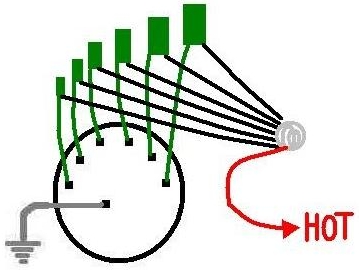 |
Here are the steps:
-
The capacitors are all soldered on consecutive
lugs on the rotary, preferably in increasing order of capacitance.
If it isn't obvious which position is which, probe it with a continuity
tester.
-
Solder together the free ends of the capacitors
(i.e., the ends not soldered to the switch).
-
Run a wire from the merged free ends to the
hot lug on the master volume (or, alternatively, directly to the jack;
electrically it's the same thing).
-
Run a wire from the common lug (most likely
near the center of the bottom) on the rotary switch to any place in the
ground side of the circuit.
-
Play guitar!
|
Further reading:
A very simple variety of the varitone can be found on some models of Gretsch
guitars in the form of a tone switch. You
can also use a varitone as a test-bed for finding good values of capacitors
for the tone switch.
Copywrite Alexplorer.
