
|
If you know anything about Paul Reed Smith (PRS) guitars, you know there are a surprising number of possibilities available through the use of rotary switches. Further, you can use these for switching combinations within a pickup or between several pickups. In fact, a rotary switch can consolidate all those toggle switches you probably have at the moment for coil tapping, phase switching, and series-parallel switching. This page provides some ideas. |
The use of a 6-position, 4-pole rotary switch gives you all the combinations possible within a humbucker:
1. Humbucker - Series - In Phase
2. Single Coil - In Phase*
3. Humbucker - Parallel - In Phase
4. Humbucker - Series - Out of Phase
5. Single Coil - Out of Phase*
6. Humbucker - Parallel - Out of Phase
* This configuration is for the neck-most coil.
 |
For the neck pick-up
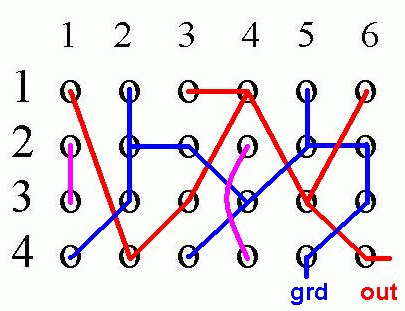
At left is a diagram of the connections to achieve the configuration described above. Connect the common lug on the rotary switch as follows:
|
 |
For the bridge pick-up
Now, if you apply this mod to a bridge position pick-up, you will probably want to tap the opposite coil so that the bridge-most coil is still hot. In that case, use this diagram. Note that all the wiring is the same for the humbucking positions; only positions 2 and 5 have been modified. |
This configuration also requires a 6-position, 4-pole rotary switch and allows you to achieve pickup switching with combinations in series and parallel with them in or out of phase with one another.
1. Neck only
2. Neck/Bridge in parallel
3. Bridge only
4. Neck/Bridge in series
5. Neck/Bridge in parallel (out of phase)
6. Neck/Bridge in series (out of phase)
(Note that the first three selections are the options on a standard 3-position switch, so they are grouped here for convenience of use.)
 |
Connect the common lug on the rotary switch
as follows:
|
If you have a guitar with two humbuckers, run each through the first configuration above, then run the output of each to another rotary as described in the second configuration described above. This will give you scores of different combinations, yet will still be manageable enough to navigate! See a mock-up of this mod and additional elaboration on this page.
In spite of the name, rotary switches do not have to be "round." They come in a variety of combinations and configurations. For example, the 5-way pick-up selector on a Fender Strat is a 5-position, 2-pole switch. There are a number of other blade switches out there such as the Megaswitch series (available from ) which mimic other more exotic combinations including the PRS combinations.Also, Yamaha makes a super 4-pole, 5-position switch (that's 20 lugs all total) which comes with example wiring configurations. Unfortunately, this too is a blade-type switch. (It is also available from )
I did find one place, , that carries a true rotary 4-pole, 5-position switch just like the PRS (they include the diagrams to accomplish the wiring scheme as well). In reality, PRS has recently stopped using this kind of switch and moved over to a printed circuit board switch that accomplishes the same thing.
Finally, just to save you some time, the only place I was able to find twist-type (as opposed to a Strat-style blade) 6-position, 4-pole rotary switches was .
 |
Home |